

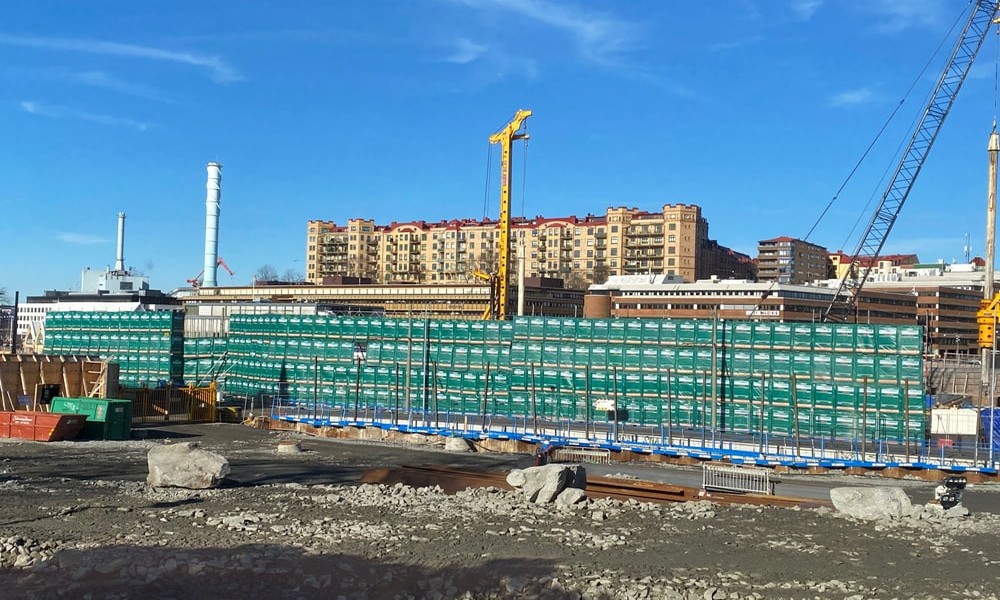
When people think about installing a noise barrier, it often sounds like a fairly straightforward step in construction planning.
You pick the type, decide where it goes along the perimeter, install it, and move on.
But in real site conditions, especially in dense urban environments, it’s rarely that simple.
What tends to matter more than the noise-absorbing barrier itself is everything that happens before it gets installed. And that’s usually where the gaps appear, not because contractors are careless, but because planning under real project pressure tends to focus on the obvious things first.
Let’s walk through some of the areas that often get overlooked.
Noise doesn’t travel the way people assume.
One of the biggest planning gaps comes from how sound is visualised on paper.
It’s easy to imagine noise as something that moves in a straight line from the source to the boundary.
But on an actual construction site, sound behaves more like it’s interacting with the environment.
Before installing construction noise barriers, it helps to think about:
- How nearby buildings might reflect sound back into the site
- How narrow gaps between structures can amplify noise
- How elevated floors or open spaces can change the direction sound travels
So even if a barrier is placed “correctly” on a plan, it might not actually be intercepting the most critical sound paths once work begins.
That mismatch is where performance issues often start.
Over-focusing on the perimeter and ignoring what’s inside.
A very common planning habit is to treat noise control as something that happens at the edge of the site.
So the perimeter gets most of the attention, while internal noise sources are not studied in detail.
But in reality, noise starts inside the site.
Things like:
- Generators running continuously
- Drilling or cutting stations
- Material loading and movement areas
all contribute heavily to overall sound levels.
If these are not considered early, a noise barrier system might end up doing most of its work too late-after sound has already spread across the site.
It’s a bit like trying to block water after it’s already flowed through the entire space.
Not planning for how the site will evolve.
Another thing that often gets underestimated is how quickly construction sites change.
What looks accurate during planning can shift within weeks once work starts.
You might begin with one layout, but later:
- Equipment gets relocated
- Work zones expand or shrink
- New structures change how space is used
If barrier planning doesn’t account for that, you end up with a setup that slowly becomes less effective over time.
A noise barrier setup that worked perfectly at the beginning may suddenly feel “misaligned” halfway through the project simply because the site no longer looks the same.
Forgetting about peak noise moments.
Not all construction work produces the same level of noise.
This is something that sounds obvious, but it often gets flattened during planning.
Some phases are relatively moderate, while others are significantly louder:
- Piling work creates deep, repetitive impact noise
- Demolition produces sudden high-energy bursts
- Heavy structural work spreads noise across multiple zones
If planning is based only on average conditions, the system may struggle during those peak moments.
And that’s usually when complaints or compliance issues tend to appear, not during the quiet phases, but during the intense ones.
So a noise barrier system needs to be thought of not just for “normal days,” but for worst-case activity too.
Small gaps that are easy to ignore, but hard to fix later.
During planning, most attention goes to big decisions like height, material type, and placement zones.
But small physical details are often left for installation teams to handle on-site.
That’s where issues can creep in.
Things like:
- Slight misalignment between panels
- Uneven ground surfaces
- Unplanned openings for access or movement
may not look significant individually, but sound doesn’t need much space to escape.
Once the system is installed, fixing these issues becomes more difficult and disruptive, especially in active construction environments.
So what seems like a “minor detail” during planning can end up having a noticeable impact later.
Not linking barrier planning with work sequencing.
Construction doesn’t happen all at once-it moves in stages.
But barrier planning sometimes happens as if everything will be active at the same time.
In reality, work shifts across the site:
- One zone becomes active while another goes quiet
- New phases begin while older areas wind down
- Different teams operate in different patterns
If a construction noise barrier setup doesn’t follow that flow, it may end up:
- Overprotecting inactive zones
- Undercovering newly active areas
- Needing frequent adjustments that weren’t anticipated
Good planning usually mirrors the way the site will actually be built, not just how it looks on a blueprint.
Underestimating how placement affects performance.
There’s also a tendency to focus heavily on barrier specs-height, thickness, material type.
But placement often matters just as much, if not more.
A barrier that is:
- Too far from the noise source
- Not aligned with the direction sound travels
- Positioned without considering surrounding structures
can underperform even if it looks “technically correct.”
Meanwhile, a simpler setup placed strategically can sometimes achieve better real-world results.
That gap between specification and positioning is something that often only becomes obvious after installation.
Final Thoughts
Planning a noise barrier system isn’t just about selecting materials and deciding where the perimeter line goes.
A lot of the real performance depends on how well the planning phase understands the actual behaviour of the site:
- How sound moves in real environments
- How construction phases will evolve
- Where noise is actually generated, not just where the site boundary is
Most challenges don’t come from the barrier itself. They come from assumptions made before it’s installed.
When planning takes those real-world conditions into account early, the system tends to work much more naturally once the project is underway-less reactive, more stable, and far closer to what was expected in the first place.
